
The Paradigm Shift in Educational Psychology #
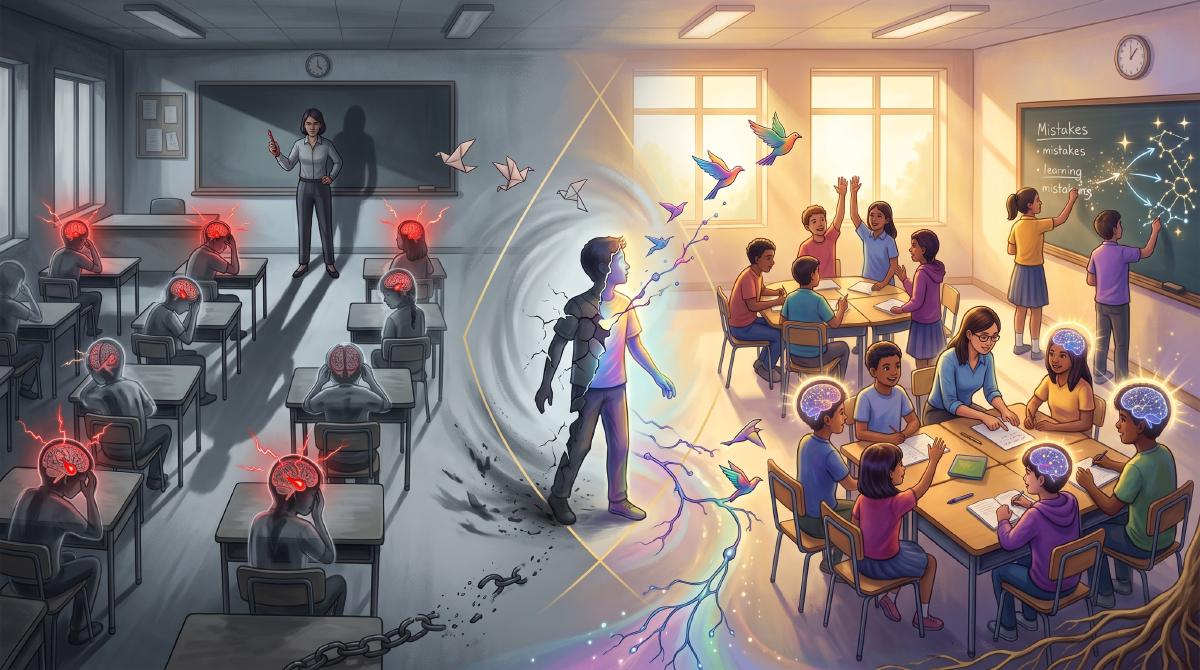
The modern educational landscape is undergoing a profound paradigm shift, moving away from rigid, behaviorist models of compliance toward socially and cognitively dynamic environments that prioritize learners’ holistic well-being. At the core of this transformation is psychological safety. Originally conceptualized and popularized in organizational psychology by Harvard Business School professor Amy Edmondson, psychological safety is defined as a shared belief within a team or learning environment that one will not be punished, humiliated, marginalized, or penalized for speaking up with ideas, questions, concerns, or mistakes. In the classroom, this concept underpins true cognitive engagement, risk-taking, and academic achievement.
For decades, traditional educational models tacitly equated academic rigor with high stress, operating under the pervasive assumption that the fear of failure was a necessary and effective motivator for student achievement. However, contemporary research in educational psychology and neuroscience demonstrates that fear is fundamentally antithetical to complex cognitive processing. When a learning environment lacks psychological safety, students perceive interpersonal risks, such as raising a hand, offering an incorrect answer, or admitting confusion, as acute threats to their social standing and self-worth. This perception of threat triggers a cascade of neurobiological responses that actively inhibit learning, forcing students to adopt self-protective behaviors that ultimately derail their academic trajectories. The cognitive load required to manage interpersonal anxiety directly subtracts from the cognitive capacity available for learning.
The transition from an environment of anxiety to one of achievement requires educators to intentionally design classrooms that neutralize social threats while maintaining rigorous academic standards. It demands a nuanced understanding of how anxiety manifests neurologically and behaviorally, how structural frameworks of safety can be applied to pedagogy, and how educators can foster environments where vulnerability is rewarded rather than penalized. Furthermore, integrating psychological safety must be carefully balanced against critical perspectives that warn against the over-therapization of the classroom, ensuring schools remain arenas of intellectual rigor rather than mere emotional sanctuaries. This article analyzes the neurobiological impacts of classroom anxiety, the structural models of psychological safety, the empirical evidence on academic outcomes, pedagogical strategies for cultivating a fearless learning environment, and the macro-level cultural integrations needed to sustain these practices.
The Neurobiology and Phenomenology of Classroom Anxiety #
To comprehend the absolute necessity of psychological safety, one must first examine the neurobiological mechanisms of anxiety and their direct impact on learning. The amygdala, a deep-brain structure responsible for emotional processing, serves as the brain’s primary threat-detection center. In a psychologically unsafe classroom, the fear of public humiliation, peer rejection, or harsh judgment activates the amygdala, triggering a physiological fight-or-flight response. This reaction diverts metabolic energy and blood flow away from the prefrontal cortex, the brain area responsible for executive functioning, working memory, and critical thinking. Consequently, an anxious student is neurologically impaired in their ability to absorb new information, synthesize complex concepts, or engage in creative problem-solving.
This relationship is vividly illustrated by the Yerkes-Dodson law, which models a bell-curve relationship between arousal (anxiety) and performance. While a very low level of stress might lead to apathy, and a moderate level can heighten focus and performance, the extreme anxiety generated by psychologically unsafe environments pushes students past the optimal peak, resulting in a precipitous decline in academic capability. The cognitive blockade induced by high anxiety manifests in several distinct behavioral phenotypes within the classroom. Educators who lack a trauma-informed or psychologically safe lens often misinterpret these neurological survival mechanisms as character flaws, deliberate defiance, or inherent learning deficits.
| Behavioral Phenotype | Presentation in the Classroom | Underlying Psychological Mechanism |
|---|---|---|
| The Disruptive Student | Acts out, refuses to follow instructions, tests boundaries, or exhibits aggression. | Operates in a “fight” response. They distrust adults and attempt to assert control over an environment they perceive as emotionally threatening. |
| The Invisible Student | Quiet, withdrawn, avoids eye contact, and never asks questions even when confused. | Operates in a “flight” or “freeze” response. They attempt to go unnoticed to avoid judgment. Teachers often ignore them because they do not cause disruptions. |
| The Perfectionist | Terrified of making mistakes, prioritizes grades over learning, masks struggles to appear highly competent. | Operates in a “fawn” response. They work themselves to exhaustion to secure approval and avoid criticism, actively avoiding tasks where failure is possible. |
| The School Avoider | Frequently absent, arrives late, or visits the nurse with somatic symptoms (stomach aches, headaches). | Emotionally Based School Avoidance Experiences (EBSA). The classroom environment is so threatening that the body produces physical symptoms to force avoidance. |
The prevalence of these anxiety manifestations is alarmingly high. An empirical study conducted among primary school children in the Russian Federation revealed that 46.87% of students exhibited a high level of anxiety, with girls (29.15%) showing significantly higher anxiety levels than boys (17.72%). A qualitative analysis of these indicators showed that the anxiety was primarily driven by social stress (24.05%), the intense need to achieve success (11.23%), fear of self-expression (7.34%), and fear of knowledge assessment situations (4.25%). Similarly, in higher education, nursing students regularly report severe test anxiety and academic stress, particularly in their second and third years of study as clinical and academic pressures mount.
The ancient philosopher Rumi once noted that half of life is lost in charming others, while the other half is lost in dealing with the anxieties others cause. This insight captures the cognitive drain students experience in an unsafe classroom. When a student spends mental energy managing the reactions, opinions, and potential criticisms of peers and teachers, that time and energy are irrevocably lost to academic pursuit.
Structural Frameworks of Psychological Safety #
To operationalize psychological safety in educational settings, researchers and practitioners rely on preeminent theoretical frameworks, most notably Amy Edmondson’s Accountability Matrix and Timothy R. Clark’s Four Stages of Psychological Safety. Together, these models dismantle the pervasive, toxic myth that psychological safety equates to lowered standards, excessive coddling, or a lack of accountability.
Edmondson’s Psychological Safety and Accountability Matrix #
A common misconception among educators is that psychological safety means creating a purely “comfortable” environment where students are insulated from stress, critique, or difficult tasks. Edmondson explicitly refutes this, demonstrating that psychological safety and performance accountability operate on two distinct, independent axes. Psychological safety is not about being universally “nice,” nor does it guarantee job or academic security. Rather, the intersection of safety and accountability creates four distinct cultural zones within a classroom or organization.
| Cultural Zone | Psychological Safety | Accountability / Standards | Classroom Characteristics & Outcomes |
|---|---|---|---|
| The Apathy Zone | Low | Low | Students and teachers are disengaged. No one feels motivated to achieve, and no one feels safe enough to connect. The environment is stagnant and going through the motions. |
| The Comfort Zone | High | Low | The classroom is friendly, warm, and collegial, but academic expectations are minimal. Students feel safe but are not challenged to grow, resulting in intellectual stagnation. |
| The Anxiety Zone | Low | High | The traditional authoritarian classroom. Expectations are immense, but students fear punishment or humiliation for making mistakes. Results in burnout, cheating, and silenced struggles. |
| The Learning Zone | High | High | The optimal educational environment. Students face rigorous academic challenges but possess emotional security to take risks, fail, ask questions, and collaborate openly. |
The Learning Zone’s true power lies in its capacity to foster productive struggle. When a teacher maintains high standards but pairs them with high psychological safety, students interpret academic difficulty as an expected, normal part of the learning process rather than a personal indictment of their intelligence. In the Learning Zone, teams and classrooms report more mistakes, not because they fail more often, but because they have the safety to surface errors early and learn from them collaboratively.
Clark’s Four Stages of Psychological Safety #
While Edmondson’s matrix defines the overarching culture, Timothy R. Clark’s framework maps the developmental progression of psychological safety within a group. Clark argues that psychological safety is a continuum based on a delicate equilibrium between two factors: respect and permission to participate. Students must successfully navigate each stage to reach their full academic and innovative potential.
The first stage, Inclusion Safety, addresses the most primal human need for belonging and connection. Before a student can learn, they must feel unconditionally accepted by their peers and their teacher, free from the threat of marginalization based on their identity, background, neurodivergence, or socioeconomic status.
Once inclusion is established, the student progresses to Learner Safety. In this stage, students no longer fear looking incompetent. Students feel secure enough to engage in the vulnerable acts of asking questions, admitting ignorance, and making mistakes without fear of ridicule or punitive grading. The educational environment transitions from an arena of performance to a laboratory of exploration.
Upon mastering the learning process and developing foundational skills, the student enters Contributor Safety. Here, individuals are granted the autonomy and permission to participate actively, apply their skills, and offer unique ideas in class discussions. The student transitions from a passive receiver of knowledge to an active, respected participant in the educational ecosystem.
Finally, the most advanced and fragile stage is Challenger Safety. In this culminating phase, students feel secure enough to question the status quo, debate with the teacher, and push back against established ideas without fear of retribution, emotional backlash, or damage to their academic standing. Challenger safety creates the intellectual friction needed for deep innovation, peer review, and critical thinking, while minimizing the social friction that normally accompanies dissent.
Clark’s linear stage model has faced academic critique. Critics argue that psychological safety is not a strict linear progression, as group dynamics are highly fluid. Furthermore, the model has been criticized for overlooking complex power dynamics, systemic privilege, and intersectionality, which can dramatically alter an individual’s perception of safety regardless of the group’s “stage.” Despite these critiques, the model remains an invaluable diagnostic tool for educators to assess which aspects of safety are lacking in their classrooms.
Empirical Evidence and Educational Outcomes #
Empirical evidence strongly supports psychological safety frameworks by linking safe environments to tangible academic and behavioral outcomes. However, the literature also reveals nuances and boundary conditions that educators must consider.
In higher education, studies show that psychological safety significantly mediates the relationship between classroom conflict and a student’s innovative competence. A multivariable logistic regression analysis of 1,207 university students found that while “affective conflict” (interpersonal clashes and emotional disputes) negatively affects innovative competence, “cognitive conflict” (intellectual debates over concepts and ideas) enhances it. Crucially, this positive effect of cognitive conflict depends entirely on a psychologically safe climate, which empowers students to voice objections and debate ideas without fear of interpersonal rupture.
Similarly, research utilizing Problem-Based Learning (PBL) teams across STEM and Health programs at Aalborg University found moderate to strong correlations among psychological safety, team creativity, and academic well-being. The study noted that students operating in psychologically safe collaborative environments were far more likely to engage in boundary-pushing behaviors, viewing themselves as active contributors to a culture of innovation rather than passive recipients of a standardized curriculum. When Transformational Teacher Leadership (TTL) champions psychological safety, teachers provide observable models and relational resources that help students assess the benefits of speaking up and taking intellectual risks.
Interestingly, the literature is not entirely monolithic. A quantitative correlational study of full-time community college students in the western United States found no statistically significant correlation between psychological safety and overall academic performance (rS = 0.073, p = 0.204), nor significant gender differences. These divergent findings highlight a critical nuance: psychological safety catalyzes learning, but it does not replace pedagogical quality. A student may feel entirely safe in a classroom. Still, if the instructional design is poor, or if the environment falls into Edmondson’s “Comfort Zone” (high safety, low accountability), academic performance will not automatically improve.
Trauma-Informed Pedagogy and Systemic Trust #
The integration of psychological safety in the classroom closely parallels the rise of trauma-informed teaching. A significant portion of the student population carries the invisible weight of Adverse Childhood Experiences (ACEs), poverty, systemic discrimination, housing insecurity, or community violence. For these students, their nervous system’s baseline state is hypervigilance. Traditional, punitive classroom management techniques, such as public reprimands or zero-tolerance exclusion, are not only ineffective for this demographic but are actively re-traumatizing.
Trauma-informed pedagogy operates on the foundational premise that all behavior is a form of communication. When a student becomes dysregulated, the trauma-informed educator shifts their internal paradigm from asking “What is wrong with you?” to “What happened to you, and how can I support you?” This approach relies heavily on establishing predictable routines and relational safety. The Substance Abuse and Mental Health Services Administration (SAMHSA) outlines six core principles that must be embedded into the classroom architecture:
| SAMHSA Principle | Classroom Application |
|---|---|
| Safety | Ensuring the physical and emotional environment is secure by using calm-down corners and predictable routines. |
| Trustworthiness and Transparency | Maintaining clear, explicit rules, providing warnings for transitions, and following through on promises to build systemic trust. |
| Peer Support | Cultivating an environment where students support one another’s emotional and academic growth. |
| Collaboration and Mutuality | Flattening the hierarchy. Engaging in collaborative problem-solving and co-creating classroom agreements. |
| Empowerment, Voice, and Choice | Offering flexible seating, assignment choices, and validating student input to counteract the powerlessness associated with trauma. |
| Cultural, Historical, and Gender Issues | Recognizing how systemic biases, racism, and marginalized identities compound trauma, and actively working to dismantle these inequities within the school. |
A critical tenet of trauma-informed teaching, and one that is frequently misunderstood, is that it does not mandate the lowering of academic or behavioral expectations11. Lowering standards out of pity effectively strips the student of their dignity and deprives them of the opportunity to build resilience and self-efficacy. Instead, the trauma-informed educator maintains high expectations while providing proportionate, individualized scaffolding to help the student meet them.
Discipline is subsequently reframed from a punitive framework to a restorative one. Rather than issuing detentions, educators utilize restorative circles and collaborative problem-solving to teach emotional literacy, empathy, and conflict repair. By addressing the root cause of the behavior and validating the student’s emotional reality, the educator co-regulates the student’s nervous system, slowly shifting them from survival back into cognitive readiness.
The Ecclestone Critique: The “Diminished Self” and Therapeutic Overreach #
While the promotion of psychological safety and trauma-informed care has undoubtedly revolutionized modern pedagogy, it has also sparked significant, necessary academic debate regarding the boundaries of the educator’s role. Prominent educational critics, notably Kathryn Ecclestone and Dennis Hayes, have vociferously warned against what they term the “dangerous rise of therapeutic education”. Their critique argues that the uncritical, widespread adoption of therapeutic language and clinical practices in schools risks pathologizing normal human struggles, setbacks, and emotions.
The “therapeutic turn” in education, Ecclestone argues, operates on a fundamentally flawed deficit model of the “diminished self”, an underlying cultural assumption that students are inherently fragile, vulnerable, and psychologically damaged, requiring constant emotional intervention to survive the educational process. This perspective suggests that an overemphasis on emotional well-being, constant psychological validation, and mandated self-disclosure can inadvertently infantilize students, fostering dependency on adult intervention and eroding their natural, intrinsic resilience.
When educators prioritize protecting students’ feelings over pursuing objective knowledge and academic challenge, they risk stripping the curriculum of its transformative power. Ecclestone highlights that the “therapization of social justice” reduces systemic inequalities to individual psycho-emotional deficiencies, distracting institutions from addressing structural issues by instead focusing on measuring “soft outcomes” like emotional literacy and self-esteem. Furthermore, a hyper-focus on emotional safety can lead to avoiding controversial, intellectually stimulating issues in the classroom, thereby impoverishing the educational experience.
This critique serves as a vital counterbalance in the discourse on psychological safety. It clarifies that true psychological safety is not synonymous with therapizing the classroom. Psychological safety is a structural, interpersonal condition designed to facilitate high performance, robust debate, and intellectual risk-taking; it is not a clinical intervention designed to cure emotional distress or shield students from the realities of the world.
Educators must learn to distinguish between productive intellectual discomfort and genuine psychological harm. Learning new, complex material is inherently uncomfortable; receiving critical feedback on a failed project is uncomfortable; debating contentious ideas is uncomfortable. If an educator conflates this necessary cognitive friction with psychological unsafety, they will inevitably default to Edmondson’s “Comfort Zone,” asking too little of their students and actively stunting their intellectual growth. The psychologically safe classroom protects students from humiliation, malice, and systemic bias; it does not protect them from the cognitive dissonance required for profound, transformative learning.
Pedagogical Architecture: Strategies for the Learning Zone #
Translating the theoretical frameworks of psychological safety into daily pedagogical architecture requires deliberate, visible actions by the educator. The goal is to normalize failure, decouple student self-worth from immediate correctness, and build a systemic infrastructure of trust.
Normalizing Failure and Productive Struggle #
In traditional classrooms, right answers are celebrated, while wrong answers are penalized, stigmatized, or quickly bypassed. This binary approach cultivates fixed mindsets, where students equate speed and accuracy with innate intelligence. Psychologically safe classrooms reframe errors not as personal failures, but as critical, expected data points in the learning trajectory.
A highly effective, widely adopted strategy for this reframing is the “My Favorite No” routine. In this formative assessment practice, a teacher collects anonymous student responses to a problem (often on index cards), rapidly sorts them, and intentionally selects a common, mathematically or conceptually rich incorrect answer to project to the entire class. Because the work is anonymized, the social threat of being wrong is eliminated. The teacher then leads the class in analyzing the mistake, first identifying what the student did correctly (validating the effort), and then collaboratively uncovering the misconception. This exercise powerfully signals that mistakes are not shameful secrets to be hidden, but valuable communal resources for deepening understanding.
Furthermore, educators can utilize “low-floor, high-ceiling” tasks. Championed by researchers like Jo Boaler, these assignments are easily accessible to all students regardless of baseline skill level (the low floor) but complex enough to challenge the most advanced learners (the high ceiling). By engaging with open-ended problems that have multiple viable solution paths, students realize that academic success is rooted in critical reasoning, peer collaboration, and exploration rather than the rapid recall of a single correct answer.
The Implementation of Wise Feedback #
Perhaps the most sensitive interaction in the educational dynamic is delivering critical feedback. When students, particularly marginalized students, minority groups, or those suffering from impostor syndrome, receive harsh grading or corrective comments, they frequently experience a phenomenon known as attributional ambiguity. They may wonder whether critical feedback is a genuine attempt to help them improve or whether it stems from the teacher’s implicit bias, stereotyping, or a fundamental belief that the student is inherently incapable. This ambiguity severely damages trust and prompts student disengagement.
To counteract this, researchers David Yeager and Geoffrey Cohen developed the concept of “Wise Feedback.” Wise feedback is a highly specific, evidence-based intervention that pairs critical commentary with an explicit affirmation of the student’s potential.
| Feedback Paradigm | Structure and Tone | Student Interpretation and Outcome |
|---|---|---|
| Traditional Critical Feedback | Focuses solely on errors, deficits, and deductions. Lacks relational context. | Triggers attributional ambiguity and stereotype threat. Leads to defensiveness, loss of trust, and academic disengagement. |
| Comfort Feedback | Overpraises mediocre work, offers easier tasks, and avoids necessary criticism to protect self-esteem. | Signals low expectations. Cultivates a fixed mindset and infantilizes the learner, trapping them in the Comfort Zone. |
| Wise Feedback | Combines an explicit statement of high standards, precise critical feedback, and an assurance of the student’s capability to meet those standards. | Eliminates attributional ambiguity. Boosts self-efficacy, restores trust, and motivates the student to revise and improve their work. |
For example, an educator might preface a heavily marked essay with: “I am giving you these comments because I have very high expectations for this class, and I know that you can reach them.” Empirical studies, including longitudinal research tracking college enrollment and outcomes for marginalized groups, demonstrate that this simple framing dramatically increases student motivation, reduces perceptions of bias, and encourages students to embrace academic struggle. Wise feedback explicitly operationalizes the Learning Zone of Edmondson’s matrix: it maintains unyielding accountability while providing a robust, visible psychological safety net.
Modeling Fallibility and Vulnerability #
A classroom’s culture is intrinsically tied to its leader’s behavior, functioning much like a micro-organizational network where the educator sets the behavioral norms. If an educator demands perfection from themselves, hides their own mistakes, or reacts defensively when a student challenges them, they inadvertently signal that perfection is the only acceptable standard for the room. This implicit demand creates serious procedural obstacles to learning; students quickly learn to mask their confusion rather than seek clarification. Conversely, teachers who actively and publicly model vulnerability create a profound sense of psychological safety, effectively acting as choice architects who make risk-taking the path of least resistance.
Educators model fallibility by openly expressing curiosity about topics outside their expertise, admitting when they do not know the answer to a student’s question, and transparently acknowledging their own pedagogical or factual errors. When a teacher says, “I made a mistake in yesterday’s lesson; let’s look at how I went wrong,” they lower the interpersonal risk for every student in the room. This flattening of the invisible hierarchy transforms the teacher from an infallible authoritarian into a lead learner, thereby inviting students to engage in the shared vulnerability of the educational process.
From a neurobiological and cognitive perspective, this modeling serves as a critical mechanism for cognitive offloading. In high-stakes, perfectionist environments, students dedicate a massive portion of their working memory to impression management, calculating the social risks of participating and attempting to conceal their deficits. This chronic hypervigilance leads to rapid cognitive depletion and decision fatigue. When a teacher normalizes fallibility, they remove this “perfection tax,” freeing the student’s cognitive capacity to focus on academic processing and productive struggle.
To systemize this vulnerability, educators can adapt strategic debiasing frameworks, such as conducting a “pedagogical pre-mortem” at the beginning of a complex unit. An educator might state, “This next concept is notoriously difficult to teach, and in the past, I have struggled to explain the second phase clearly. Let’s anticipate where we might get stuck together.” By preemptively owning potential failure, the educator dismantles the illusion of effortless mastery. The classroom shifts from a transactional environment defined by compliance into a dynamic, cognitively optimized ecosystem where errors are leveraged as essential diagnostic data.
Teacher Emotional Intelligence and Career Sustainability #
The successful implementation of psychological safety relies almost entirely on the educator’s emotional intelligence (EI), which essentially functions as the primary cognitive shield for the classroom ecosystem. An educator’s EI encompasses their self-awareness, emotional regulation, empathy, and relationship management skills. Because classrooms are highly dynamic social ecosystems, the teacher’s emotional state operates through profound emotional contagion. A dysregulated, highly stressed teacher inadvertently cultivates a dysregulated, anxious classroom environment. This contagion directly affects students’ cognitive load; when they must constantly monitor and adapt to a volatile adult’s emotional state, they expend valuable working memory on survival and impression management, leaving insufficient capacity for deep academic processing.
Research indicates a strong, positive correlation between a teacher’s emotional competence and effective classroom management. Teachers with high EI are adept at reading students’ subtle emotional cues, allowing them to proactively de-escalate conflicts and respond to defiance with empathetic curiosity rather than authoritarian control. By using empathy instead of punitive measures, the educator removes the procedural obstacles that typically trigger student defensiveness. This emotional modeling acts as a sophisticated form of choice architecture in the classroom, guiding students toward self-regulation by making rational, calm communication the path of least resistance. It gives students a real-time framework for managing their frustrations and setbacks, building self-esteem and empathy.
Furthermore, teacher EI acts as a crucial buffer against the occupational burnout and decision fatigue that heavily plague the education sector. The daily demands of teaching constantly test an educator’s executive metabolic limits. Empirical studies using structural equation modeling show a chain-mediated effect: a teacher’s emotional intelligence directly enhances psychological empowerment, which mitigates cognitive depletion and strengthens career commitment, ultimately leading to higher rates of innovative teaching behaviors.
Conversely, environments that lack psychological safety for teachers, where school administration leads through fear, compliance, and micromanagement, directly degrade teachers’ capacity to provide a safe harbor for their students. Viewed through the lens of organizational network analysis, an authoritarian administration creates structural bottlenecks that prevent the downward flow of trust. If educators constantly manage their own anxieties about leadership evaluations, they lack the cognitive bandwidth to foster psychological safety for their learners. The architecture of psychological safety must therefore be systemic. It requires a comprehensive culture-transformation roadmap that flows uninterrupted from educational leadership to faculty and, ultimately, to the student body.
Power Distance and the Challenge of Dissent #
In cross-cultural educational psychology, Geert Hofstede’s dimension of “Power Distance” plays a pivotal role in how individuals perceive, navigate, and enact psychological safety. Power distance refers to the extent to which less powerful members of institutions accept and expect unequal power distribution. In cultures with high power distance, common in parts of Asia, the Middle East, and Latin America, steep hierarchies are the systemic norm, and challenging authority is often interpreted as deeply disrespectful or insubordinate. From a behavioral science perspective, these steep hierarchies inadvertently introduce severe procedural obstacles into the learning and feedback process. The cognitive load of continuously calculating the interpersonal risk of speaking up effectively silences marginalized voices and limits the upward flow of vital information.
In such environments, achieving the first three stages of Timothy R. Clark’s model (Inclusion, Learner, and Contributor safety) may require explicit facilitation. Still, achieving the fourth stage, Challenger Safety, presents a profound cultural hurdle. When challenging an educator or a senior leader is culturally equated with career or academic sabotage, students and subordinates will naturally self-censor. This self-censorship must not be misdiagnosed as a lack of engagement; rather, it is a highly rational, adaptive response to a choice architecture that heavily penalizes dissent. Viewed through the lens of organizational network analysis, high power distance creates structural bottlenecks where knowledge remains trapped at the bottom of the hierarchy because silence has been engineered as the path of least resistance.
Fostering Challenger Safety in high power distance cultures requires leaders and educators to go to extraordinary lengths to explicitly solicit dissent, publicly reward pushback, and actively dismantle the presumption of infallibility that their title traditionally affords. To overcome this deeply ingrained conditioning, educators must employ systemic debiasing frameworks that institutionalize questioning. For example, integrating structured “Pre-Mortem” exercises, where students are explicitly tasked with predicting why a proposed concept, project, or methodology might fail, can temporarily suspend the traditional hierarchy. By mandating critique as a formal procedural requirement rather than an act of interpersonal defiance, educators transform intellectual friction from a social risk into an expected academic competency. Ultimately, true systemic transformation in these contexts occurs only when the leader actively engineers an environment where expressing a divergent perspective is safer than remaining silent.
Conclusion: The Architecture of Academic Achievement #
The transition from an anxiety-driven educational model to one defined by profound academic achievement requires a systemic recalibration of the learning environment. As this article has demonstrated, psychological safety is not a pedagogical luxury, nor is it a therapeutic intervention designed to coddle learners. Rather, it is the foundational architecture required to optimize cognitive load. When students operate in environments plagued by hypervigilance and interpersonal threat, their executive functioning is hijacked by the need to manage social risks. By intentionally dismantling these procedural obstacles, educators liberate critical working memory, allowing students to engage deeply with complex material, sustain productive struggle, and achieve genuine intellectual growth.
Creating this cognitively optimized ecosystem requires a delicate, deliberate balance, captured at the intersection of high psychological safety and unyielding accountability. To avoid the pitfalls of therapeutic overreach and the “diminished self” critique, educators must employ a sophisticated choice architecture. This involves designing classrooms where taking intellectual risks, making errors, and offering dissenting views are systematically structured as the paths of least resistance. Frameworks such as the “pedagogical pre-mortem” and the application of wise feedback serve as vital debiasing mechanisms, ensuring that the classroom remains a rigorous arena of intellectual friction rather than a stagnant comfort zone.
Furthermore, this transformation cannot occur in a vacuum; it is fundamentally a systemic imperative. Cultivating Timothy R. Clark’s Challenger Safety, particularly in cross-cultural contexts marked by high power distance, requires educators and institutional leaders to dismantle entrenched, steep hierarchies actively. This demands a high degree of emotional intelligence from teachers, who act as the primary cognitive shield for their students, proactively de-escalating anxiety through empathetic curiosity. However, teachers cannot sustain this emotional labor without a macro-level culture transformation roadmap, one where institutional leadership models vulnerability, prioritizes systemic equity, and builds a sustainable infrastructure of trust.
Ultimately, creating psychologically safe classrooms is a profoundly strategic endeavor. It requires shifting the educational paradigm from one that penalizes fallibility to one that leverages human vulnerability as a catalyst for innovation. By neutralizing the neurobiological triggers of anxiety, educators do more than protect their students’ emotional well-being; they unlock the absolute upper limits of their cognitive and academic potential.